The Business Owner’s Wake-Up Call: “We’re Profitable... So Why Can’t We Pay Rent?”
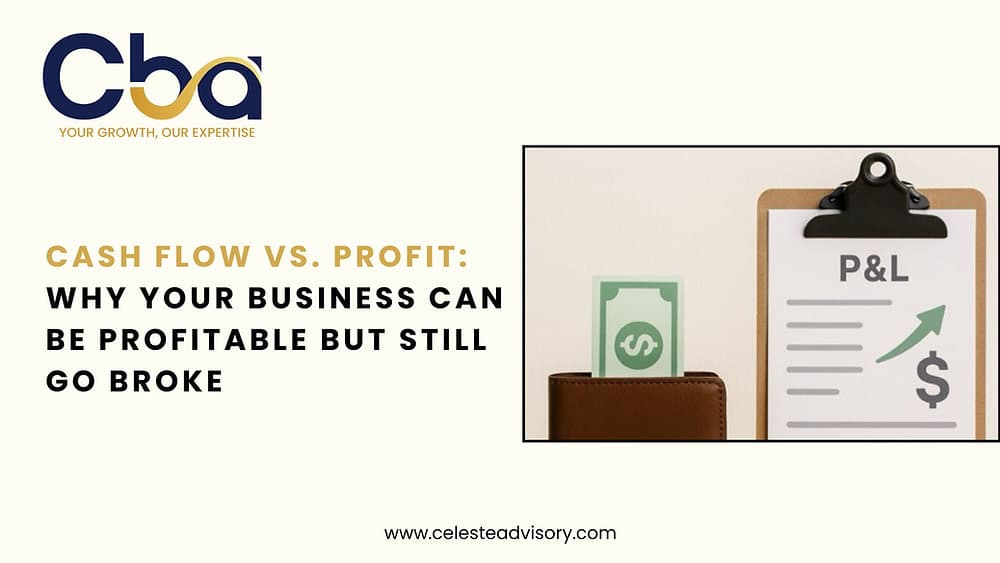
Ever looked at your Profit & Loss (P&L) report and smiled… only to open your bank account and feel a wave of panic?
You’re not alone.
A business can be profitable on paper and still go broke in real life.
This isn’t just a scary idea—it’s something we’ve seen play out again and again at Celeste Business Advisors LLP, especially in fast-growing service businesses.
The culprit? Confusing cash flow with profit.
In this blog, we’ll break down:
- What’s the difference between cash flow and profit?
- Why profit doesn’t always mean liquidity
- Simple analogies and visuals to make it stick
- How to track both the right way
- Tools (like QuickBooks, Xero, and Fathom) that make life easier
Let’s clear up the confusion once and for all.
What Is Profit? (The Report Card)
Profit is what’s left after your business earns revenue and pays its expenses.
It’s an accounting concept, and it usually appears on your Income Statement (P&L).
💡 Quick Analogy:
Think of profit like your school report card. It tells you how well you did in class—but it doesn’t tell you if you’ve got money in your backpack to buy lunch today.
There are different types of profit:
- Gross Profit: Revenue minus direct costs (like freelancers or materials)
- Operating Profit: After admin and overheads
- Net Profit: What’s left after everything, including taxes and interest
✅ A positive profit means your business model works.🚫 But it doesn’t mean you have cash in the bank.
What Is Cash Flow? (The Wallet)
Cash flow is about movement of money—cash in vs. cash out.
It tracks the actual cash entering and leaving your business.
You’ll find this in your Cash Flow Statement, not your P&L.
💡 Quick Analogy:
Cash flow is your wallet. It’s how much money you actually have on you, right now, to pay for stuff.
There are 3 main types:
- Operating Cash Flow: From your day-to-day business
- Investing Cash Flow: Buying equipment or investing in tools
- Financing Cash Flow: Loans, repayments, or equity
✅ Good cash flow = bills get paid, salaries run smoothly🚫 Bad cash flow = stress, missed payments, sleepless nights
Profit vs. Cash Flow: Key Differences at a Glance
Here’s a quick comparison table to make it crystal clear:
Feature | Profit | Cash Flow |
Found in | Profit & Loss (P&L) | Cash Flow Statement |
Includes | Revenue & expenses (on accrual) | Real cash in and out |
Tells you | If you made money (on paper) | If you can pay bills (in reality) |
Can be positive while... | You're running out of cash | You're losing money but still liquid |
Analogy | Report card | Wallet |
The Big Mistake: “We’re Profitable, So We Must Be Fine!”
Let me give you a real story.
We had a client—let’s call them BrightSide Studios, a fast-growing creative agency. Their P&L looked great. Revenue? Up 40% year-over-year. Net profit margin? A healthy 18%.
But their cash flow?
🚨 They were constantly borrowing from their overdraft just to make payroll.
What went wrong?
- They were billing clients in 30–60 day cycles
- Payments were often delayed
- They prepaid software tools and paid freelancers upfront
So, the P&L said they were profitable—but the cash flow told a different story.
Simple Visual: The Leaky Bucket
Imagine this:
You’ve got a bucket.
- You’re pouring water in (revenue)
- But there are holes at the bottom (expenses)
- You also have to wait 30 days for the tap to turn on (delayed payments)
Even if more water is going in than leaking out, you might still run dry before it fills.
That’s the cash flow struggle.
Common Scenarios Where Cash Flow ≠ Profit
1. Invoice-Based Businesses
You close deals. You send invoices. But if clients pay late (or never), cash flow tanks—even with healthy profit margins.
2. High Upfront Costs
Service businesses often pay contractors or platforms first, then collect money later. Timing matters!
3. Inventory or Prepaid Expenses
Even though they’re assets, they consume cash. Profit ignores that; cash flow doesn’t.
4. Loan Repayments
Loan principal doesn’t show up on your P&L—but it does affect your bank balance.
5. Delayed Tax Payments
You show big profits, but forget to set aside cash for quarterly taxes. Come tax season? Panic.
How to Tell If You Have a Cash Flow Problem
Here are a few warning signs:
- You constantly wait for client payments to pay vendors
- You avoid looking at your bank balance
- You delay hiring because of cash uncertainty
- You use your credit card to cover business expenses
Even with solid profits, these are cash flow red flags.
How to Fix Cash Flow While Staying Profitable
Now let’s talk solutions. Here’s how we help clients get back in control.
1. Watch Your Payment Terms
Don’t just invoice clients—incentivize early payment.
- Use net 15 instead of net 30
- Offer 2% off for payments made within 10 days
- Add late fees (and enforce them!)
2. Tighten Up Collections
Use tools like:
- QuickBooks A/R Aging Report
- Xero’s Invoice Reminders
- Tesorio for automated follow-ups
Assign a team member (or yourself!) to chase late payers every week.
3. Track Cash Flow Weekly
Yes, weekly—not monthly.
Set up a simple tracker:
Week | Expected Inflows | Expected Outflows | Net Cash Position |
1 | ₹4,00,000 | ₹3,00,000 | ₹1,00,000 |
2 | ₹2,00,000 | ₹2,50,000 | -₹50,000 |
This small habit = huge peace of mind.
4. Maintain a Cash Buffer
Aim to keep 2–3 months of expenses in reserve. If that sounds impossible, start with one week. Then one month.
Build it like an emergency fund.
5. Use Rolling Forecasts
Forecast revenue, expenses, and cash for the next 3–6 months. Update monthly based on actuals.
Tools like Fathom or Datarails make this easy. If you’re a spreadsheet wizard, Google Sheets will do just fine.
Tools to Help You Track Profit & Cash Together
Here’s how to automate this without making your head explode.
Tool | Tracks | Bonus Features | Website |
QuickBooks | Profit, A/R | Invoicing + P&L + Bank sync | |
Xero | Profit, Cash | Auto reminders, cash flow chart | |
Fathom | Cash forecasts | KPIs + rolling cash flow + visuals | |
Datarails | Forecasting | Budget vs actuals, real-time view | |
Tesorio | Collections | A/R automation & cash flow insights |
Quick Cheat Sheet: Profit vs. Cash Flow Checklist
Task | Profit | Cash Flow |
Sent an invoice | ✅ | ❌ |
Collected the payment | ✅ | ✅ |
Paid for software annual plan | ✅ | ✅ |
Got a loan approved | ❌ | ✅ |
Paid employee bonuses | ✅ | ✅ |
Final Thoughts: You Need Both to Stay in Business
Here’s the truth I share with every founder I work with:
Profit is a sign of potential. But cash flow is the key to survival.
Your business needs both.
- Profit tells you the model works
- Cash flow tells you if you can stay afloat
- Together? You thrive—not just survive
✅ Ready to Fix the Gap Between Profit and Cash?
At Celeste Business Advisors LLP, our celesteadvisory.com/fractional-cfo-services are built for service-based businesses that want to:
- ✅ Track both profit and cash flow with confidence
- 📊 Set up smart financial dashboards using QuickBooks, Xero, or Fathom
- 📉 Forecast cash accurately—without Excel meltdowns
- 🛠 Fix the leaks in your financial bucket before it's too late
Whether you're scaling fast or just tired of flying blind, we bring the clarity, systems, and CFO-level insights to help your business stay cash-strong and strategy-driven.
📞 Schedule a free consultation today👉 Visit celesteadvisory.com 📩 Or email us at consulting@celesteadvisory.com
Let’s turn your financial data into smarter decisions.
Celeste Business Advisors is proudly Fathom Certified, XERO Certified,
QBO Certified, and our team includes seasoned CPAs and CMAs to provide comprehensive financial guidance.
Click Here For A Free Consultation With Our Expert